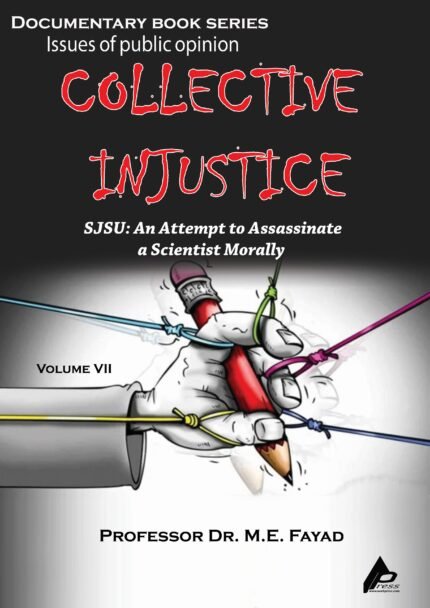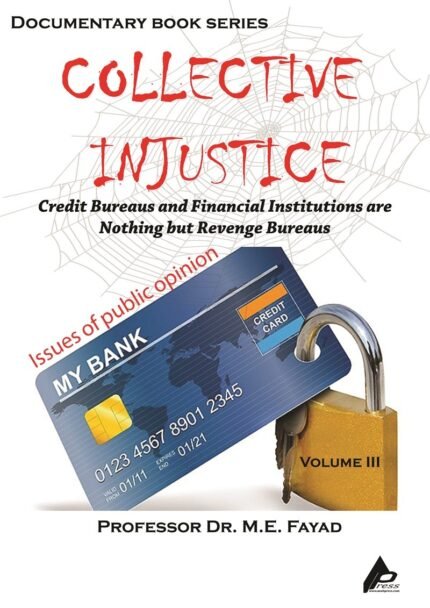
COLLECTIVE INJUSTICE (VOLUME 3) Credit Bureaus and Financial Institutions are nothing but Vindictive Bureaus. by Professor Dr. Mohamed Fayad
I have suffered a lot from the mistreatment of companies, banks,
credit bureaus, and Wells Fargo, which I think colluded with the
bank I deal with and deliberately destroyed my financial reputa-
tion and all my business, which negatively affected all my activi-
ties and deprived me of my economic rights by publishing false in-
formation about me to all financial institutions and all parties
that need a financial report on me. In the last six years, I have
compiled a complete record of all credit companies and their offic-
es, due to which I wasted a lot of time contacting all of them on
the phone and writing correspondence to them. However, they
didn't help me with anything. Moreover, I didn't get any support
from them to compensate me for what I suffered, like severe
losses and damages, and they unjustly robbed me of money.
Please consider these allegations of mine because they are tough.
You can check the evidence attached to the book, which includes
the latest information about my bank and credit cards and con-
tains many errors and contradictions. I am tired of being reject-
ed and unwarrantedly mistreated by all banks.
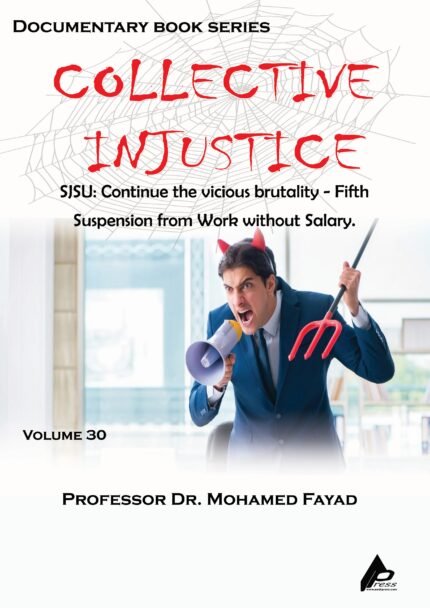
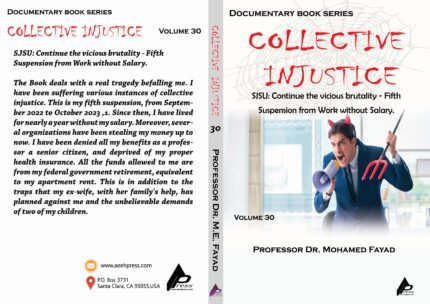
COLLECTIVE INJUSTICE (VOLUME 30)SJSU: Continue the vicious brutality – Fifth Suspension from Work without Salary.- by Professor Dr. Mohamed Fayad
SJSU: Continue the vicious brutality - Fifth
Suspension from Work without Salary.
The Book deals with a real tragedy befalling me. I
have been suffering various instances of collective
injustice. This is my fifth suspension, from Septem-
ber 2022 to October 2023 ,1. Since then, I have lived
for nearly a year without my salary. Moreover, sever-
al organizations have been stealing my money up to
now. I have been denied all my benefits as a profes-
sor a senior citizen, and deprived of my proper
health insurance. All the funds allowed to me are
from my federal government retirement, equivalent
to my apartment rent. This is in addition to the
traps that my ex-wife, with her family's help, has
planned against me and the unbelievable demands
of two of my children.
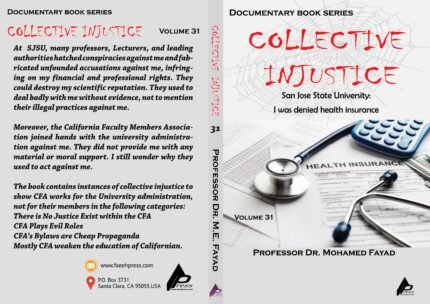
COLLECTIVE INJUSTICE (VOLUME 31)San Jose State University: I was denied health insurance- by Professor Dr. Mohamed Fayad
At SJSU, many professors, Lecturers, and leading
authorities hatched conspiracies against me and fab-
ricated unfounded accusations against me, infring-
ing on my financial and professional rights. They
could destroy my scientific reputation. They used to
deal badly with me without evidence, not to mention
their illegal practices against me.
Moreover, the California Faculty Members Associa-
tion joined hands with the university administra-
tion against me. They did not provide me with any
material or moral support. I still wonder why they
used to act against me.
The book contains instances of collective injustice to
show CFA works for the University administration,
not for their members in the following categories:
There is No Justice Exist within the CFA
CFA Plays Evil Roles
CFA's Bylaws are Cheap Propaganda
Mostly CFA weaken the education of Californian.

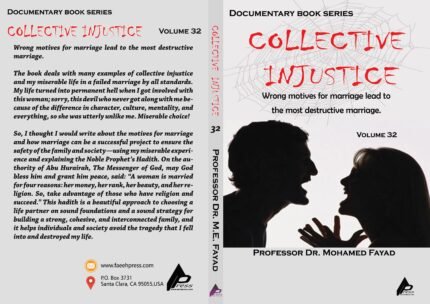
COLLECTIVE INJUSTICE (VOLUME 32)Wrong motives for marriage lead to the most destructive marriage.- by Professor Dr. Mohamed Fayad
Wrong motives for marriage lead to the most destructive
marriage.
The book deals with many examples of collective injustice
and my miserable life in a failed marriage by all standards.
My life turned into permanent hell when I got involved with
this woman; sorry, this devil who never got along with me be-
cause of the difference in character, culture, mentality, and
everything, so she was utterly unlike me. Miserable choice!
So, I thought I would write about the motives for marriage
and how marriage can be a successful project to ensure the
safety of the family and society-using my miserable experi-
ence and explaining the Noble Prophet's Hadith. On the au-
thority of Abu Hurairah, The Messenger of God, may God
bless him and grant him peace, said: "A woman is married
for four reasons: her money, her rank, her beauty, and her re-
ligion. So, take advantage of those who have religion and
succeed." This hadith is a beautiful approach to choosing a
life partner on sound foundations and a sound strategy for
building a strong, cohesive, and interconnected family, and
it helps individuals and society avoid the tragedy that I fell
into and destroyed my life.
COLLECTIVE INJUSTICE (VOLUME 33)Poor Internet and Phone Services- by Professor Dr. Mohamed Fayad
Poor Internet and Phone Services
The book contains several instances of collective injustice of many
organizations, such as internet and phone services like Verizon,
AT&T, Comcast, Google Services in email, and AdSense. Here are a
few instances of their collective injustices:
1 - Verizon Communications Inc .:
The company does not meet its obligation. Not only does it owe me
a lot of money, but it also causes me a lot of damage. Therefore, I
stopped my business with this company, but it is still withdrawing
money from my account at Wells Fargo, which is still giving it pay-
ment for the last three months.
2 - Comcast Corporation
This company denied providing me phone services for more than
three months. It forced me to pay a lot of money for Xfinity. Moreo-
ver, it inserted nasty remarks to credit bureaus about me.
3 - Google Email Services and AdSense
They took a lot of money from me for poor security services. Moreo-
ver, they caused a lot of damage to all my websites and email sys-
tems. This cost me a lot of time and money to be fixed. AdSense
owes me a lot of money as income from my channel on YouTube and
prevents me from continuing to conduct my business on YouTube
for years.
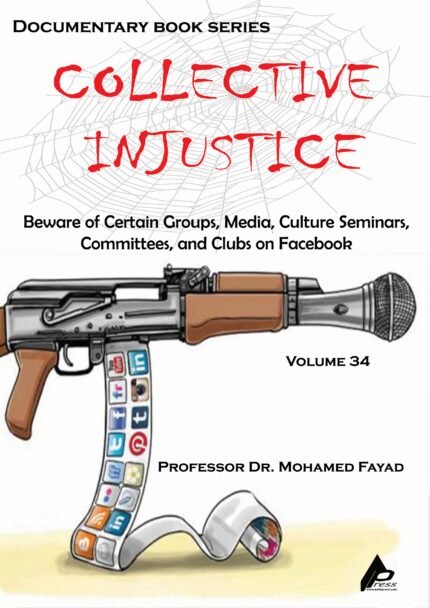
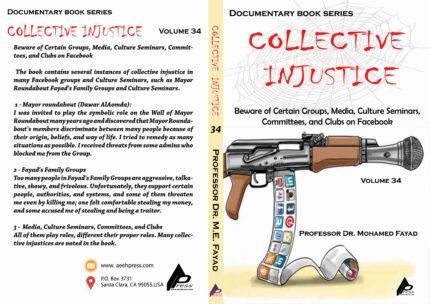
COLLECTIVE INJUSTICE (VOLUME 34)Beware of Certain Groups, Media, Culture Seminars, Commit- tees, and Clubs on Facebook- by Professor Dr. Mohamed Fayad
Beware of Certain Groups, Media, Culture Seminars, Commit-
tees, and Clubs on Facebook
The book contains several instances of collective injustice in
many Facebook groups and Culture Seminars, such as Mayor
Roundabout Fayad's Family Groups and Culture Seminars.
1 - Mayor roundabout (Dawar AlAomda):
I was invited to play the symbolic role on the Wall of Mayor
Roundabout many years ago and discovered that Mayor Rounda-
bout's members discriminate between many people because of
their origin, beliefs, and way of life. I tried to remedy as many
situations as possible. I received threats from some admins who
blocked me from the Group.
2 - Fayad's Family Groups
Too many people in Fayad's Family Groups are aggressive, talka-
tive, showy, and frivolous. Unfortunately, they support certain
people, authorities, and systems, and some of them threaten
me even by killing me; one felt comfortable stealing my money,
and some accused me of stealing and being a traitor.
3 - Media, Culture Seminars, Committees, and Clubs
All of them play roles, different their proper roles. Many collec-
tive injustices are noted in the book.
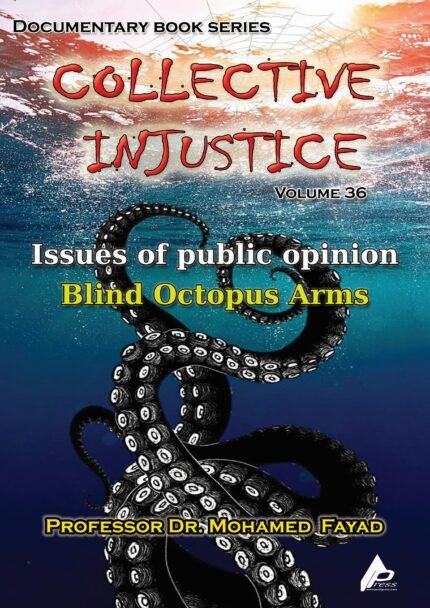
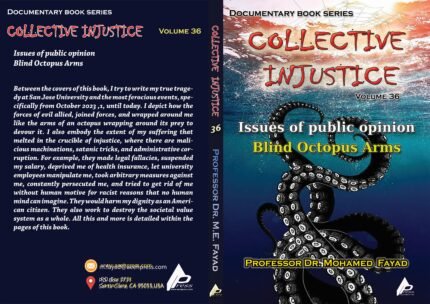
COLLECTIVE INJUSTICE (VOLUME 36)Issues of public opinion Blind Octopus Arms- by Professor Dr. Mohamed Fayad
Issues of public opinion
Blind Octopus Arms
VOLUME 36
Between the covers of this book, I try to write my true trage-
dy at San Jose University and the most ferocious events, spe-
cifically from October 2023 ,1, until today. I depict how the
forces of evil allied, joined forces, and wrapped around me
like the arms of an octopus wrapping around its prey to
devour it. I also embody the extent of my suffering that
melted in the crucible of injustice, where there are mali-
cious machinations, satanic tricks, and administrative cor-
ruption. For example, they made legal fallacies, suspended
my salary, deprived me of health insurance, let university
employees manipulate me, took arbitrary measures against
me, constantly persecuted me, and tried to get rid of me
without human motive for racist reasons that no human
mind can imagine. They would harm my dignity as an Ameri-
can citizen. They also work to destroy the societal value
system as a whole. All this and more is detailed within the
pages of this book.
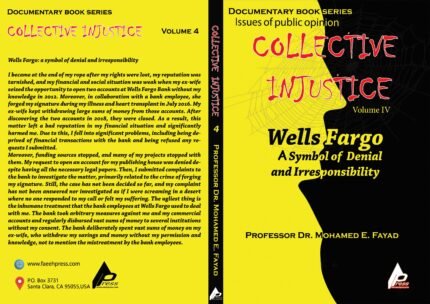
COLLECTIVE INJUSTICE (VOLUME 4) Wells Fargo: a symbol of denial and irresponsibility- by Professor Dr. Mohamed Fayad
I became at the end of my rope after my rights were lost, my reputation was
tarnished, and my financial and social situation was weak when my ex-wife
seized the opportunity to open two accounts at Wells Fargo Bank without my
knowledge in 2012. Moreover, in collaboration with a bank employee, she
forged my signature during my illness and heart transplant in July 2016. My
ex-wife kept withdrawing large sums of money from those accounts. After
discovering the two accounts in 2018, they were closed. As a result, this
matter left a bad reputation in my financial situation and significantly
harmed me. Due to this, I fell into significant problems, including being de-
prived of financial transactions with the bank and being refused any re-
quests I submitted.
Moreover, funding sources stopped, and many of my projects stopped with
them. My request to open an account for my publishing house was denied de-
spite having all the necessary legal papers. Then, I submitted complaints to
the bank to investigate the matter, primarily related to the crime of forging
my signature. Still, the case has not been decided so far, and my complaint
has not been answered nor investigated as if I were screaming in a desert
where no one responded to my call or felt my suffering. The ugliest thing is
the inhumane treatment that the bank employees at Wells Fargo used to deal
with me. The bank took arbitrary measures against me and my commercial
accounts and regularly disbursed vast sums of money to several institutions
without my consent. The bank deliberately spent vast sums of money on my
ex-wife, who withdrew my savings and money without my permission and
knowledge, not to mention the mistreatment by the bank employees.
COLLECTIVE INJUSTICE (VOLUME 5) Avana San Jose & Monticello Apartments in Santa Clara: The Tenant who is the Landlord’s Victim- by Professor Dr. Mohamed Fayad
The first six months of living in the apartment were passed peacefully with-
out any disturbances. However, after a while, I faced many problems when I
moved to a new apartment. I met issues with the apartment owner due to
negligence and delays in maintenance dates, which led to huge losses and
damage to my stock of food inside the freezer for more than three months,
which increased my financial burden. Moreover, the people there could have
been more cooperative. They refused to carry my things or purchases into
the apartment because it was on the second floor. Not to mention the racist
behavior against me in emails and correspondence, as if there was an organi-
zation or paid people behind it.
To make matters worse, they sent me a petition from their attorney demand-
ing 420$ in fees, which I had nothing to do with. I called my attorney for
twenty minutes of legal advice over the phone for 110$. He advised me to pay
the amount and that there was no need for problems because I would not be
able to buy or rent a house if I did not pay. The amount has now reached one
thousand dollars, in addition to the losses resulting from neglect of mainte-
nance, estimated at five hundred dollars. It cost me over 1200$. The apart-
ment rent is about three thousand dollars per month. You paid it on time. I
have the case number filed against them at the police station because the
apartment affected my health. Moreover, I asked them to repair it at my own
expense. Still, they refused, and no one listened to me, so I decided to leave
this place if I received all my dues in total and had an official certificate from
them guaranteeing my residence in an apartment unsuitable for human
living.
COLLECTIVE INJUSTICE (VOLUME 6) An Inauspicious Start at San Jose State University- by Professor Dr. Mohamed Fayad
My tragedy at San Jose University began when I was invited to
attend an interview for my university appointment in July 2002.
During that time, I met a university professor called Gilda Pour,
who was of Iranian origin and was working at the university. She
begged me not to accept the university's offer to work there. Un-
fortunately, I did not take her advice, and I received the letter of
appointment after the university dean assured me everything
would be fine. I met many Silicon Valley scientific groups encour-
aging me to live in the area. Then, I returned to my office at Lin-
coln University and received a phone call from a university facul-
ty member who spoke to me rudely and told me there was no
place for me at the university. What a bad start! I immediately
called the dean, who asked me not to worry, but after I returned
to the university, I was surprised that he had left after a short
period. This book includes many examples of ill-treatment by
some university faculty members, except for one or two people
who treated me kindly and one of whom arranged a convenient
place to stay at the beginning of my stay in San Jose.